In two days the E-Display went from a bare controller board to a 4.26″ e-paper panel painting ink landscapes that drift slowly across the screen. Generative art is now the project; the weather screen stays possible but comes second.
Day one: the board alone (1 October 2026)
The first step left the screen in its box. The controller board (an Adafruit Feather ESP32-S3 with 8 MB) went on a USB-C data cable to the Mac, the 1500 mAh battery on its switch cable, and a test program onto the board. If the screen stayed blank later, these parts would already be ruled out.
Nearly everything passed: the Mac saw the board, it compiled and flashed, the fuel gauge answered, the LED blinked, the battery held a steady 4.00 V, the board ran on battery alone, and it joined Wi-Fi and could be controlled from a phone. Only battery life with Wi-Fi on was still open. It was measured later: 26 h, in the ED-01 datasheet.
Five things that day taught:
- With no battery plugged in, the gauge still showed 4.1 V, falling, at 101.9 %. A real cell holds steady.
- The gauge needs minutes to learn. It said 99.9 % at 4.00 V; the truth was about 80 to 85 %.
- A charge-only USB cable powers the board, but no port appears.
- On USB the battery charges, so unplug before any battery test.
- Deep sleep hides the USB port. Hold BOOT, tap RESET, then upload.
Day two: the first screen (2 October 2026)
Two header strips were soldered onto the board, nine wires plugged on, and the panel drew. Two details decided whether it showed anything at all: the firmware has to drive the screen's power pin high, and this panel wants a short reset pulse.
A full refresh of the whole panel takes 2.4 to 2.8 s. A partial refresh takes 0.42 s, or 0.87 s for a larger window.
Paintings that move
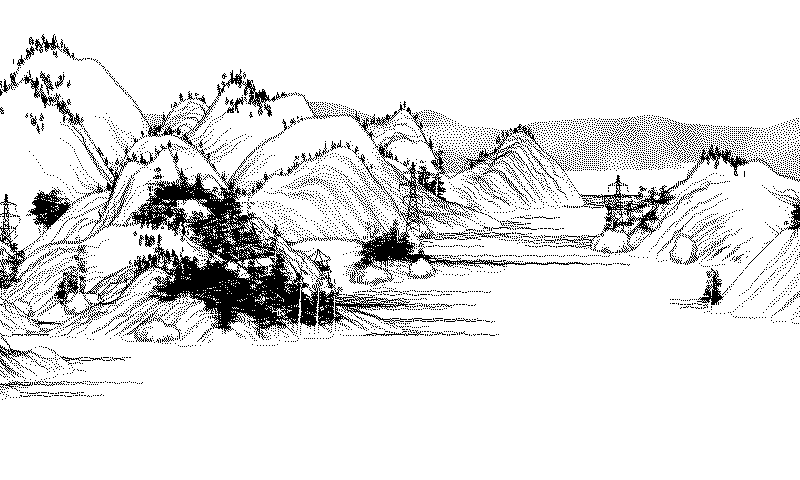
A landscape is drawn as one long strip, 1800 × 480 pixels and 108 KB. The board downloads it once and slides an 800-pixel window along it, a few pixels at a time, with partial refreshes. Sending each window straight to the display controller, instead of through the graphics library's paging, cut one frame from 1515 ms to 877 ms.
The Mac draws the art and serves the settings. The board reads them with every painting it downloads, so scroll speed, step size and refresh rhythm change from a control page with no reflash. When new firmware is needed, it goes on by drag and drop: double-tap RESET, the board appears as a drive, copy one file.
Seven styles ran then: Shan Shui landscapes, a landscape inscribed with a Song ci poem, birds, fish, flowers, vertical poems and calligraphy strokes. They are open-source generators, most of them by Lingdong Huang, whose work is ink, line and Chinese text: exactly what a 1-bit e-paper panel does well. The ones still in use are on the Projects page; the inscribed landscape was dropped on 2026-11-04.
Next
- A battery test is running, the frame painting and drifting on battery alone. The result, 26 h in live mode, is on the ED-01 datasheet.
- Print the case and fit everything.
- Move the styles that are pure maths, the birds, fish and strokes, onto the board itself, so the frame can paint without the Mac.