The internet has revolutionized the way we communicate with each other, making it easy and reliable to get access to information or services like phone calls. To offer a network that can communicate hundreds of millions of users, intricate technologies have to be used to reach the capacities needed. In today’s networks, the most powerful communication links use laser fiber optics. Using lasers and optical fiber to send and receive information has been researched since the 1980s but recently new developments in machine learning are enabling researchers to extract as much capacity as possible out of the current and old optical networks. In today’s world we expect technology to improve at a faster rate than ever, this puts huge pressure on the industry to innovate and look for new ways of thinking old problems.
In any communication system noise is the limiting factor that reduces the length at which we can communicate or how much information can be sent. Currently, the most powerful tool to send information at long distances at the fastest speed possible is Fiber Optics Communication. Fiber optics have enabled the communication revolution we are living in so it’s necessary to always improve on and innovate. Optical noise in a communication system comes from the material’s response to light propagating through it. Light pulses are sent through a silica glass fiber with an “Intensity” and an “Offset” with respect to a reference. The transmitting laser can reach four different intensities and have any of four offsets, such that sixteen combinations can be reached.
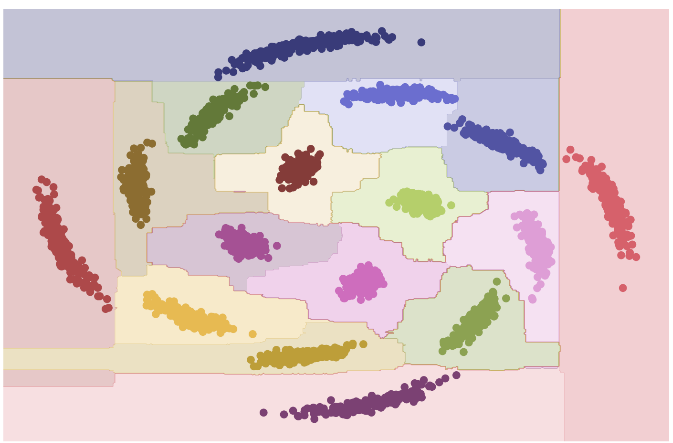
When detecting a pulse, the main interest is to retrieve the intensity and offset of the signal, if there is distortion in the system, these parameters will be shifted. This distortion increments the chance for the pulse to be misclassified. The standard method of classification is done based on probability regions that are computed using physical models that need all the fibers characteristics to improve the signal. Machine learning can be used to learn the type of noise in the system and make accurate decisions with a model that needs no information about the system.
New detection schemes assisted by machine learning are helping improve the systems reliability by learning the noise source of the system in use and reducing its simplicity by requiring less information. This is useful in a similar way as you knowing the way your old car likes to be driven, when you are driving it you have learned what the car doesn’t like, you know how to work around its problems. With this new method transmission length could be extended up to 500 km in ideal conditions. This is great to extract as much possible of old and new communication links deployed improving the internet and making it more robust.
Edits: “since the 1980” → “since the 1980s”; “materials response” → “material’s response”; “Machine learning” → “machine learning” mid-sentence. Nothing else changed.
2026 note
The thesis puts the gain in numbers: at the optimal launch power the learned receiver could increase the transmission length “anywhere from 2.5 times (same performance as the analytical DSP) to 9.4 time longer (length predicted by exponential fit)”. The full story, with interactive figures, is on the thesis page.