Six years after the MSc, the same simulation files went through the same comparison again, with today's tools and two new receivers: a one-parameter physics fit and a small neural network. The 2020 result holds, and the new receivers show where the physics ends and the learning begins.
01 The question again
A long fibre link turns bright symbols further than dim ones, and amplifier noise makes the turn random. The 2020 thesis asked whether a receiver could learn its decisions from the received symbols alone, without a model of the fibre, and found that it could stretch the reach of a long link. The re-run asks the same question, plus two new ones: how much of that gain a single physics parameter would already give, and how many known symbols each receiver needs before it works.
02 The setup
The data is the thesis simulation: 16-QAM over 64 spans of 80 km, at six launch powers from 0.17 to 2 mW, 2048 symbols per span (16 384 at 2 mW). Every receiver gets the same budget: the first K symbols of a span are known pilots, and it decides the rest.
| Receiver | How it decides |
|---|---|
| Conventional | Pilots fit one common phase and amplitude, then the nearest grid point |
| Analytical compensation | The thesis's model-based scheme, then the same fit |
| Kerr fit | One parameter: turn each symbol back in proportion to its power |
| Random forest, SVM | The thesis's learned receivers |
| Small neural network | Two hidden layers of 32 (new) |
03 Reach
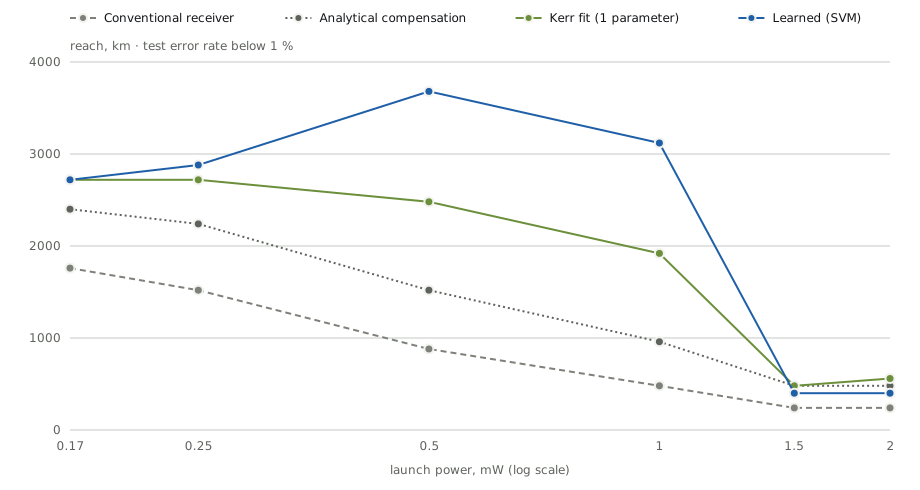
At 1 mW the learned SVM keeps the error rate below 1 % for 3120 km. The analytical compensation manages 960 km and a conventional receiver 480 km. That is 3.3 times the compensation, in line with the 2.5 times the thesis reported at a stricter error rate.
The surprise is the Kerr fit. One fitted number reaches 1920 km, twice the analytical compensation. Most of what the fibre does at these powers is that one rotation. The learned receivers only pull ahead beyond about 2000 km, where amplifier noise smears the rings and a single rotation is no longer enough.
At 1.5 and 2 mW nothing helps: every receiver fails within about 500 km. The distortion there is no longer a map that can be learned from a few hundred symbols.
04 How many pilots
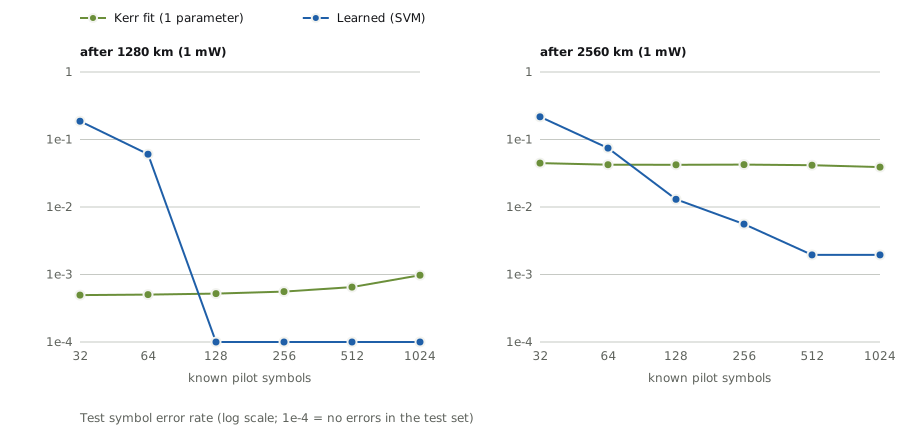
The two kinds of receiver learn differently. The Kerr fit is as good with 32 pilots as with 512: one number does not need much data. The SVM needs about 128 before it is useful, then keeps improving.
That points at the idea behind the thesis: a short known pattern at the start, so each span calibrates quickly. A physics fit gives the fast calibration; learning gives the last stretch. Run in that order, the Kerr fit first and the SVM on its output, the error rate at 3840 km falls from 9.1 % to 6.0 % with 128 pilots. At shorter distances it changes nothing.
05 What it says
- The 2020 result holds: on a long single-channel link, a learned receiver reaches about three times further than the model-based compensation.
- Most of that gain is one physical parameter. Learning earns its place where the noise is.
- The small neural network is not the winner. On two inputs and a few hundred pilots, the SVM matches or beats it at every launch power.
06 Limits
With about 1000 test symbols per span, error rates below 10⁻³ cannot be resolved, so reach is read at 1 % rather than the thesis's 10⁻⁵. Pilots come from the same frame they are tested on. It is one single-channel simulation: no WDM and no measured link. Everything here reproduces from the code and results in about four minutes.